Average Reviews:

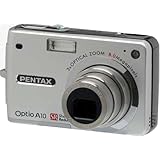
(More customer reviews)My Pentax Optio S died in Sapporo and I didn't have time or inclination for a travel repair, so I went in to Yodobashi Camera to see what they had. I looked at some Cannon but settled on Pentax again figuring I wouldn't have a steep learning curve. I was right. It runs very similarly to all the Optio family. It's slightly larger than the Optio S line but is still as small as it gets.
Yodobashi had 3 Pentaxes for me to choose from: 1 had a touch screen (useless IMHO), and the other was waterproof to 1.5 meters. At least at Yodobashi, viewfinders on digital cameras were things of the past. The A10 had 8 megapixels and a "Shake Reduction" which both looked appealing. I purchased it, swapped my SD card from the old to the new and headed for the old government building and a ramen shop.
Results:
The shake reduction is an option in both still and movie modes. However, I didn't notice an improvement unless I was using a small tripod. It really sharpened up a slightly shaky tripod but if you were moving, there wasn't much improvement.
The zoom sucked until I understood it. It is not a continuous feed but a step feed in 6 steps. You push the zoom button for just an instant and the zoom will move by a 1/6 increment. Not really a big deal, but it was annoying when I was expecting an infinite choice.
Also with the lens, the wide angle isn't quite as wide and the zoom is a bit more telephoto than on the old Pentax. I would prefer having the wider as on the Optio S but taking 2 steps back doesn't make that big a difference.
Green button - Great button. You can assign 4 function settings, shake reduction, re-initialize, or movie mode to this button. When I was taking short movies for a while, I assigned "movie" to this button and with 1 push I was in that mode. At all other times I assigned Fn to the button to quickly access EV compensation (back light), Saturation, AE Metering (Spot, Avg, full), and white balance.
Modes - You have to go here to record sound, unlike the S line, where you just hold the "on" button down for a few seconds. You also get a few more modes which I didn't use much. For example, "Text" mode increases contrast to bring out black writing on a light background, and with "Candles" you can get extra speed in low light, where it is not available elsewhere. Each mode may have its own little peculiarities. As mentioned by someone else, this is the only thing that doesn't reset to the defaults when you power off. When you power on again, it's still on "text" or "pets" and if you don't notice, you can ruin some pictures or make some color look black and white (I did this after taking a picture of a sign in text mode). I mainly use "P" so I can adjust everything manually and have it hold. If you use "Auto," many choices are grayed out and you have to change modes to change the choice.
Screen - LCD screens and sunlight don't mix. I've used a large Panasonic with an LCD screen and couldn't see a thing either. I generally put my palm over the screen to shade it and then bring it close to my eye to see the image. I may not be able to focus on it well at 3" but I can make out the borders of the image well enough to push. I've also noticed that view finders on small digital cameras don't match the "what you see" with the "what you get." On this one though, you don't have to worry about it because you have to use the screen.
Movies - I only take 30 second shots of something that's moving or has sound just as a memory. This camera gives two resolutions 320 and 640. It works for me since I'm really not taking movies and I'm satisfied with what I get (something good enough for a web site).
Controls - Easy - all the buttons are on the right side of the rear: zoom at the top, view under that, circle toggle for mode, focus, flash, and timer under that, then the menu and "green" button below that. The screen takes up the rest of the back. The top has the off/on and shutter, and a "Shake Preview" that doesn't do anything that I can tell.
Flash - the flash is a bit weak and you can notice darkening at just 10 feet. And yes, in every mode there's a pre-flash, in case that flower has its eyes closed. The "red-eye" is a bit more delayed than the standard. It doesn't bother me any more than the delay on the autofocus. If I want the shutter to go when I push I use manual focus and sports settings.
Grip - Until you develop the "4th finger under, index finger on top" 1-hand method, it's a 2-hand camera if you want to adjust anything. The big screen on the back only gives you a cm square place to put a fingerprint among the buttons.
Battery - the battery is the same that Pentax uses in their other Optios, the D-LI8. Because the battery never got a good review, I've always carried a spare. However, I've never used the spare and just a recharge every night has kept it good. You might be able to power it down in a day, but just taking around 50 pictures and a couple of short movies in a day never got me close to a dead battery.
Play - this camera also has a plethora of useless (and handy) but fun editing tools. In view mode if you push "mode" you get digital filters to turn the photo to sepia or black and white, or adjust the color balance turning off all green and blue and just leaving red and other combinations. You also get:
Slideshow
Resize
Crop (trimming)
Copy (to camera's built in memory and back)
Image rotate
Digital Filters (a bit of PhotoShop built in)
Brightness filter
Movie Edit (get rid of the ends)
Red-eye (after flash process)
Voice Memo
Protect
DPOF (print right from the camera)
Frame composite (put two images together - usually a frame around a pix)
I also noticed that on equal resolutions, the A10 files were stored at a smaller size than on the Optio S. I therefore increased my default resolution. I only use the 8 mega pixel 3* resolution for images I know I will want to get a large print from. I do this to save SD card space.
I got this one because I was in a bind. I think it's better than my old Optio S, but after use, I would like to see Pentax's second A10 model, whenever it comes out, and if my old camera were still kicking I would have waited, because with just some small changes this could be a much better camera. It's the camera to carry with you at all times to get that shot that you otherwise would have missed because the camera was back in the hotel.
Pentax has released a firmware update for this camera to improve the focusing, a version 1.01 that you can download from Pentax and install via an SD card. The instructions are contained in the zip download. There have been several reports that once the update is made, the lens doesn't return all the way into the body when powered off. I've had the update in for several weeks with no problem so it could be another problem.
Another problem reported is that of a broken LCD screen. Apparently, extra force or dropping the camera can easily shatter or crack the screen. This is not covered by the warranty and is a $120 repair from Pentax in Colorado. Get a good rigid case, and don't sit on or drop the camera. Perhaps one of the stick-on anti-glare screens would protect it from sharp contacts.
For examples of what the camera can do, I've uploaded several pictures that you can access in the upper left of the product screen. For being so small, it does a great job. If you want the best, you'll have to carry it like an SLR (K10D for example).
Click Here to see more reviews about: Pentax Optio A10 8MP Digital Camera with 3x Optical Zoom and Shake Reduction
MD) CL) PENTAX OPTIO A10 DIGITAL CAM


0 comments:
Post a Comment