Average Reviews:

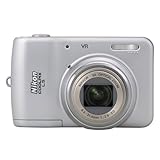
(More customer reviews)The Nikon Coolpix L5 offers lots of features in a fairly compact size. I've already found it to take excellent pictures in a variety of situations. I've been using a DSLR (Nikon D70) for a couple of years now, and while this won't replace it, I wanted something small and lightweight for hiking and backpacking trips where the D70 system would be just too much. The headlines, of course, are the 7.2MP image size, the 5x optical zoom, and the VR vibration reduction (image stabilization). It also uses 2 standard AA batteries (alkaline or rechargeable), which is much more convenient in remote locations than a custom rechargeable battery pack.
I've found image quality to be excellent. I haven't run detailed comparisons (I'm sure plenty of other people will soon report on line pair resolution, etc.), but zooming in on the Photoshop image shows crisp images and excellent detail. The wide zoom range is also a plus, compared to the 2x-4x zoom in other cameras. You zoom by pushing either the wide angle or telephoto ends of a rocker switch. Because the lens zooms so rapidly, it's really hard to achieve precise control over the focal length. You have to learn how to briefly tap the control to achieve the desired result, but if you're used to the precise zooming of a DSLR you'll be disappointed with this feature.
There are several different exposure modes. In most cases you can simply use the Auto mode. In special situations you might want to use one of 15 preset modes. Exposures have usually been right on, although backlit subjects can be a little bit of a challenge in the Auto mode. The camera gives you two ways to deal with this. First is a Back Light mode, one of the 15 preset modes you can select. Second is a way to post-process the image in the camera through something called D-Lighting, which compensates for backlighting after you have made the exposure (the adjusted exposure is saved as a separate file, so your original is not altered). I've only played with these a little bit, but they definitely improved the image.
You can also adjust exposure by dialing in compensation in 1/3-stop increments. It's great as far as it goes, but I would have liked the option of full manual f/stop and shutter speed control. The built-in flash is helpful for portraits, although as usual in this kind of camera, it's a bit anemic beyond about 10 feet. You can turn the flash off in auto mode, although in some of the preset modes, it gets turned back on whether you want it to or not. One of the preset modes is called Museum Mode, which turns off the flash and allows you to take pictures in situations where flash photography is prohibited. Like all compact digital cameras, you can only get JPEG files, not RAW format.
The user controls are fairly intuitive, once you get used to them. Commonly-used controls such as exposure compensation, self timer, macro mode, and flash on/off have dedicated buttons. Other controls are accessed through a menu button. The Vibration Reduction control at the top of the camera has three modes: off, normal, and Active. In normal mode, you can still pan to follow moving subjects. Active mode is for stationary scenes. It definitely works, and you can see noticeable improvement in photos with it turned on. But don't expect it to solve all your problems. It does a reasonable job of compensating for camera shake in handheld situations, but it won't be as good as using a tripod. Also, don't expect it to compensate for subject movement. I used it to shoot an indoor party in low light without a flash, and if the subjects were moving, they showed up blurred in the photo. Using the flash helps, but because of the anemic flash power the background goes dark.
The 2.5" screen is very bright and fairly sharp, although not high-definition. The camera doesn't have an optical viewfinder, so in bright sunlight you have to shield the screen to compose the shot. The screen is still bright enough to view in these situations.
You can also use it in a video mode to record both video and sound with its built-in microphone, but other than a quick experiment that seemed pretty good, I haven't used this and so can't comment on how good it is.
Another interesting feature is the ability to do in-camera crops of existing photos. After taking a photo, switch to the Review mode, then use the zoom and pan buttons to zoom into a specific region of the photo. Push the shutter button and the camera creates a new photo of just the enlarged area. It's not anything you can't also do in Photoshop, but it is clever. I used it on the two photos of the rose I submitted here so you can see an enlarged view of a typical photo.
The other camera I looked at before buying this one was the Canon A710IS. Both are superficially similar. They are both 7MP, both have image stabilization, and both have similar zoom ranges (Canon is a little better at 6X). The Canon has the edge with an optical viewfinder and more capability to control the exposure. But it is also larger and heavier, which was a disadvantage for me. Neither camera is exactly miniscule, but the Nikon will at least theoretically fit in my pocket. I felt the Canon was just too large. Plus the Canon was $100 more expensive, which wouldn't have stopped me if I thought it was enough better, but I didn't.
The camera comes with 2 alkaline AA batteries, but I use rechargeables. I got about 200 photos using a pair of 2500 mAH NiMH rechargeable batteries, including lots of time reviewing photos, deleting a lot of them, turning the camera on and off numerous times, and zooming regularly. The camera doesn't come with a memory card, but it does have 8MB of internal memory to store a few shots. I use a 1G high speed SD card from SanDisk. I strongly recommend a high speed card (about 9 MB or 60X transfer rate).
Overall, I'm happy with the camera and look forward to taking it on a lot of expeditions where the D70 would be left behind.
Click Here to see more reviews about: Nikon Coolpix L5 7.2MP Digital Camera with 5x Optical Vibration Reduction Zoom


0 comments:
Post a Comment