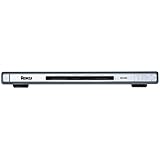
Average Reviews:

(More customer reviews)I am now on my third week with the HD1000, I believe I now can give a fair review.
My first week was spent struggling with the networking of the unit. Normally, networking is not an issue with most users, but in my particular application some tech support would have been nice. I say "would have been nice" because there is very limited effort put forward by Roku on this. Their website even states that tech support is only available via email, although they are more than happy to talk to you live, if you are placing an order. The response time is a few days, and then they tell you to call back a long-distance # - not exactly what I had in mind. Problem was solved on my own. I would not count on tech support from these guys, you are better off getting help from other users at the Roku's forum (http://www.rokulabs.com/forums/)
Picture viewing was great. My 5 mega-pixel picts looked very nice at the 1080i setting. The mp3 playback was sufficient to playback, but seemed lacking as far as playlists, control, shuffle and format. Watching pictures and listening to music at the same time is not possible with the limitation in memory, although Roku says otherwise. In order it to work, you must use a CompactFlash card as a swap drive, otherwise the system will freeze up and you will have to reboot. This hack is a comprimise for its deficiency in the memory. Although the ATI chip does suggests high performance, the 64MB (half of which is reserved for video) does not, hence the CF hack. Using the swapfile does solve all freezing issues. Plan on using one if you ever buy into the HD1000. The HD1000 then feels much more robust. It is then the perfect tool for viewing your high res pictures and a decent mp3 player. The ATI chip, the component output to 1080i video and the digital output for audio are the right tools for the job.
I believe currently the biggest problem is that the firmware development is incomplete. The video playback is virtually non-existent, as well as the advertised visualizer. This lack of development of its firmware is what is really holding back this product. The lack of firmware development is an ongoing topic of discussion at the Roku Forums, although Roku itself, does not seem to be interested in participating. I can understand why there is a lack of Roku participation in the forums on this topic, it is because there has been a lack of development in the firmware. The last firmware update was nine months ago. That's pretty bad, when you consider the fact that the product still does not do what it is supposed to. I think Roku stopped advertising the fact that the HD1000 will play back mpeg2 streams, but page 15 of the user manual still claims this a viable feature. The only support for the video playback, is through third-party software, which is really at the beta stage. You can get some playback, but there are lip-synch and control problems that are inherient with the pending firmware update. Again, until the firmware is updated, this aspect of the HD1000 is incomplete and insufficient.
Although the limited memory issue does present some problems that would be difficult to workaround, I do think that the success of the HD1000 is close at hand, but is directly dependent on the development of the firmware. I consider myself a person who hopes that Roku will truly be succesful in their endeavours, being that they are the only ones that currently support HD, use an open platform, and do not require server-side software. I just hope they focus on developing their creation and foster it into greatness, rather than obsolescence.
I suggest before buying, the consumer check the progress of the firmware update (to be announced as v1.6) on the Roku Forums at http://www.rokulabs.com/forums/ and judge for themselves. I hope to soon retract all negative comments mentioned in this post if, and when, Roku resolves these problems.
(Dec. 11)- I would like to update that the anticipated v1.6 is to be released in Decemeber 2004, but it will be a beta release. Sounds as if it may be a patch for the various bugs, but perhaps it will also have some added functionality. We will have to wait and see. Roku's CEO did state on the Roku forums, that a software cycle for this type of product is normally around 12 ~ 18 months! I am hoping that this upgrade is more than a bug fix, being that it may be a long time for another update after this one and that are a some major outstanding issues! Current software functionality and how frequent a manufacturer updates its software are aspects the buyer should definetly consider before spending the money. The Roko CEO also stated that Roku recommends that the buyer purchases their product soley on what it does today, and not what it may be able to do in the future. If that is the case, it would seem that if you are looking for a media player with functional video playback, then the HD1000 is not for you, today.
(Jan 3, 2005) The HD1000, aka the PhotoBridge, is in the process of evolving! Roku has just released the beta of v2.0. Although it is hard to believe that the current functionality of the 2.0 beta is the result of nearly a years worth of work, it is a step towards where it should be. The beta so far does seem to be primarily a bug fix with the addition of video playback functionality, although still quite limited and buggy, nothing ground-breaking (yet) - but again, a work in progress. Hence, I will update this review and modify my rating when the work is complete. Hopefully progress will be made at an exponentially faster rate! See what the update addresses and what is to come upon the official release for yourself at...
http://www.rokulabs.com/support/HD10002.0Beta.php
The HD1000 also has been upgraded hardware-wise, to address the lack of RAM. Apparently, Roku has been shipping 128MB versions (version B, opposed to the original version A with 64MB) for the last 2 months, but did put forward any communications. Good for new customers, but it sounds as if early adopters and recent customers are S.O.L. I wonder if version A owners will find their units obsolete, once apps are created requiring the 128MB. I fear that Roku will have no options for us other than offering the old Swap Hack. Personally I have concerns regarding the longevity of my Compact Flash card (used as swap disk), being that flash media has a finite cycle life.
Click Here to see more reviews about: Roku HD1000 High-Definition Digital Media Player
Early Adopters Pick: October 2003. This is the world's first high-definition digital media player.
Whether you're already equipped with a high-definition TV or still using a standard CRT set, the HD1000 from Roku puts all manner of digital entertainment before your eyes and ears. Tap into a home computer network, hook the unit up to a stereo, or simply pop in a memory card--then sit back and enjoy your favorite photos, artworks, music, or LiveArt (full-motion images of beaches, waterfalls, etc.).
While it will work on nearly any monitor, the HD1000 was designed to make the most of a high-definition television's brilliant color and pristine clarity. The HD1000 makes viewing and sharing treasured digital photos easier and more exciting than ever. Photos displayed through the device will look crystal-clear on your high-definition or big-screen TV. No more crowding around a PC monitor in your cluttered den--the HD1000 lets you relax and view digital slideshows in a leisurely atmosphere.
Not watching a program on your wall-mounted plasma display? Now you can create stunning wall art with a click of your remote. Roku's Art Packs (not included) are a simple way to enhance your décor and make use out of an idle HDTV. Choose from a range of images--classic masterpieces, stunning nature scenes, or a lifelike aquarium--and bring them to life in your living room. Or, use LiveArt to change your surroundings without changing your location. Bring a rippling mountain lake, a leafy summer forest, or a white sand beach with soothing waves to turn your living room into a pool of peace and tranquility. The HD1000 supports looping HD MPEG2, standard JPEG images, and MPEG clips. (Art Packs come on CompactFlash memory cards; just pop in the card and choose your favorite scenery.)
Next, liberate your growing library of digital music files from your PC and listen to them through a home stereo. Roku lets you listen to files on any of various memory cards (CompactFlash, SD, MMC, Memory Stick, SmartMedia) or over a simple Ethernet or Wi-Fi connection, so you can enjoy your favorite music through the high-quality sound system in your living room. Its attractive onscreen display shows the current media source and displays its contents as well as the media file in play, with full ID3 data for music files.
The HD1000 offers built-in protection to reduce the risk of image burn-in on your TV screen, too. (The unit can't prevent all types of burn-in, of course--it's ultimately your responsibility to use your display's manual and common sense to prevent burn-in.) The HD1000's Screen Saver mode engages when the HD1000 is your primary video source, and it can even step in whenever one of your other video sources stops moving. When placed in a pass-through configuration--with the signal from a DVD player, say, passing through the HD1000 on its way to a screen--the HD1000 can detect when the video input source is still and will automatically generate a changing Screen Saver.
The HD1000 is based on the Roku OS, an open platform that includes Roku's advanced media APIs and the Linux Kernel, and for which other companies can design as-yet-undreamed-of accessories.
What's in the Box HD1000, user's manual, remote control, remote batteries (two AAA), a component-video cable, a stereo analog audio interconnect, and an AC power cable.

Click here for more information about Roku HD1000 High-Definition Digital Media Player

0 comments:
Post a Comment