Average Reviews:

(More customer reviews)(Illustrations available at the product pages for this card and also the linked page for Logisys Power Supply)
Attention: Amazon now offers a Version 2 of this product: Asus nVidia GeForce GT220 1 GB DDR3 VGA/DVI/HDMI Low Profile PCI-Express Video Card ENGT220/DI/1GD3(LP)/V2
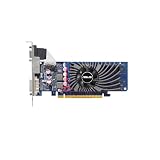
I bought this for my parents Windows-7 computer, adding a competitively priced mid-level graphics module with excellent 3-D/video acceleration. It almost got returned, but I'm too stubborn to let go of it. It's not a 'silent' card either. And while GT 220 is optionally available in custom factory configuration from HP, you'll pay a couple hundred dollars extra, since the dinky power supply (standard rating 220 watts where 350 watts were needed) is only limited availability, and must be replaced to keep the GT 220 happy.
Nowhere on manufacturer or retailers product pages could I discover any power supply requirement for the ASUS GT 220. It turns out ASUS leaves a link to a power supply calculator on their 'TROUBLE-SHOOTING' section. So if you select the 'graphics card' category of the 'trouble shooting page there's a link in the left hand column to a calculator page.
From that link you can plug in the values of how many hard drives, optical drives, memory modules, how many processors, how many cores, how many graphics cards (single or SLI-dual or SLI-triple) and your power supply needs will be displayed. Such a pity they couldn't install this link on the regular PRODUCT page.
This means I installed the card and it handled web-surfing and e-mail with the 220 watt PSU. But when I opened a 3D application (in this case THQ Titan Quest) the graphics card experienced heat failure impedance in about 10 minutes of game play. Only then did I discover the PSU calculator in the trouble shooting section of ASUSTEK web-site.
If other customers are contemplating this card for an HP Pavilion slimline, it is workable. This model of HP case only allows access to one PCI-E x1 and one PCI-E x16, expansion slots. Our 1x slot is occupied by a fax modem, so the dual-slot low-profile bracket included isn't useful for us. (You could use a dremel Hobby Tool to cut the VGA section out of the way.)
I don't need the HDMI interface, so I just appropriated an extra Low-profile bracket from one of my PNY cards that wasn't being used. I downloaded the most recent driver from nVidia and the one for this card also supports my 6000 series on-board graphics. (So I was able to complete the driver install with no disk and before plugging in the card.
Windows 7 made no fuss at all, instantly enabling the new card driver automatically the first time I turned it on. (I did use the start-up set-up in bios to select PCI-E as the primary display before I started Windows.)
After I confirmed my power supply recommendation from the ASUS calculator (For a week I ran my hard drive and optical drive on a separate PSU, while the on-board PSU ran the processor main-board functions with an open case) I ordered a new Logisys 575W 20+4-pin Dual-Fan ATX Power Supply - SLI Ready
from Amazon that satisfies up to 450 watts requirement. At the same time I ordered extension cables for the 24-pin ATX, the 4-pin CPU plug (ATX) and the SATA power plugs on the hard drive and the optical (DVD) drive. Happily, only one of the drives needed an extension beyond the ample length of the Logisys PSU cables. :^)
Of course it could all be built into another case, (other projects come first) but opening up the back side of the HP seems to satisfy the heat dissipation needs of this unit, which generates Boo Koo heat, for such a small appliance. We're talking Macy Gray "light up like a candle whenever he calls, melt like a candle whenever we touch" heat, heat, heat.
In the rear of the case behind the CPU is a tang of metal that pops out with a screw driver for better ventilation. Also the old PSU, when removed supplies a needed cooling air source incidental to the graphics card and it's buzzing little heat-sink. The machine work on that heat-sink is very sharp! Opening up the rear of the case was the only way to run 3-D intensive action without actually leaving the case wide open.
Click Here to see more reviews about: ASUS Geforce GT220 PCI-E 2.0 1 GB DDR2 Low Profile Graphics Card ENGT220/DI/1GD2 (LP)


0 comments:
Post a Comment