Average Reviews:

(More customer reviews)My computer hasn't been upgraded much since I built it a few years ago. When I built it, I decided to go with integrated network adapters and audio. My aBit motherboard's onboard audio was a reasonably good Realtek HD audio chip so I was content to stick with it rather than buying a discrete audio card, like I'd done in all of my previous builds. I decided the convenience of having integrated components was worth the small sacrifice in quality.
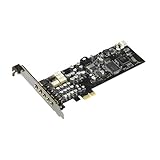
About a year ago, I started using headphones heavily on my PC and became dissatisfied with the noisy onboard audio. I thought the best way to resolve this was to get an external USB DAC/headphone amp. While I got amazing sound, it wasn't quite as convenient as I expected it to be and decided a discrete audio card was probably my best choice. I settled on the Asus Xonar DX PCI Express card.
PROS:
- Stellar 116 dB SNR for front audio ports (112 dB for rear)
- Front panel header
- Dolby Pro Logic IIx and Dolby Headphone support
- Low profile bracket included in addition to regular height
- Great sound quality via a pair of Cirrus Logic DAC's
CONS:
- Requires floppy-style Molex 4-pin connector for power
- Does not autodetect headphone insertion
- Software-based EAX 5.0 support
I badly wanted to get an ASUS Xonar Essence STX Card, or comparable card with a built-in headphone amp and very high quality DAC. Unfortunately, I found it hard to justify parting with $200. I then narrowed my choices down to the more affordable options of the Asus Xonar DX and the Creative Labs X-Fi Titanium cards. When I found out that the X-Fi Titanium didn't include support for front-panel headers, it was an easy choice. Besides, the Xonar DX had a better rated SNR (116dB front/112dB rear vs. 109dB).
INSTALLATION
Installation took me about 10 minutes. It would've been even quicker if I didn't have to move one of my other cards out of the way to install it. My PCI-E x1 slot was taken up by my USB 3.0 expansion card so I inserted it into my other PCI-E slot. Also, unlike other sound cards I've used in the past, the Xonar DX required it's own power so I had to use the included Molex adapter and plug it into my power supply. I disabled my onboard audio in the BIOS, installed the latest Windows 7 64-bit drivers, rebooted and was in business.
SOUND QUALITY
I began my audio testing by playing my FLAC audio files on my puny built-in speakers on my Samsung monitor. All of the sudden, the sound quality was actually bearable coming from my monitor. The clarity of the audio improved by a factor of two or three. I then moved onto my headphones-- my primary reason for upgrading. I plugged my Sennheiser HD 555's into my front panel headphone jack but got no sound. Oops, did I install the header pins backwards? I opened my case back up and double checked but all looked well. I then realized that the driver installation also installed the Xonar DX Audio Center application and I had to manually switch the analog out to the front panel headphone jack. Eww. The Realtek onboard audio chip automatically detected when I inserted headphones in and swapped the audio over to them without my intervention. This would have been a hassle not worth dealing with had the sound quality pumping through my headphones not been amazing.
My music sounded wonderful! The bass was immensely improved on my bass-challenged HD 555's and every other measure of sound quality was noticeably improved over the onboard audio I'd been used to listening to for three years. Next up were movies. I played high action scenes from the last Star Trek movie and Avatar and was, B-L-O-W-N away. I fiddled with the Dolby Headphone settings and realized for the first time that they weren't gimmicks at all. I truly felt surrounded by the motion picture. I love action adventure and science fiction films and I now had a proper setup for optimum enjoyment! Also, the noisy audio from my PC was virtually eliminated. With the onboard audio, I heard all the EMF interference but with the Asus Xonar DX, it was barely audible.
GAMES
I was a big-time gamer back when Half-Life, Unreal Tournament and WarCraft III were out. These days, fatherhood has had a serious impact on my ability to find time for games so aside from the occasional game of Bejeweled, I only find myself playing Age of Empires III. I thought the sound was terrific but I can't judge just how great it works with more modern games. I do know that due to the software-based support of EAX 5.0, games that use EAX aren't quite as good as having hardware support of EAX 5.0, like the X-Fi Titanium.
CONCLUSION
I am over the moon with the Asus Xonar DX. Music and movies have never sounded so good on my PC. If you have EAX 5.0 games, you might be better off with the X-Fi Titanium, but I really needed support for front-panel headers. Maybe some day I will be able to justify the audiophile quality audio cards, but until then, I will be enjoying the Xonar DX without regret. I can't recommend this card highly enough.
Click Here to see more reviews about: ASUS Xonar DX 7.1 Channels PCI Express Interface Sound Card
 Get 1% OFF
Click here for more information about ASUS Xonar DX 7.1 Channels PCI Express Interface Sound Card

0 comments:
Post a Comment